Showing posts with label games. Show all posts

1/22/2012

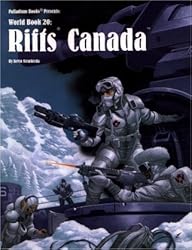
Rifts World Book 20: Canada Review

Rifts World Book 20: Canada
Average Reviews:

(More customer reviews)
I've played Palladium games since I was first introduced to the system in 1986 by way of the Robotech RPG. I was one of the first adopters of the original Rifts in 1990, and followed the line fanatically and faithfully for many years. I'm no stranger to Palladium products. As they say, familiarity breeds contempt, so I lost my enthusiasm for Palladium products and stayed away for several years. When I heard about a new edition of Rifts, the hype was enough to bring me back.
Big Ol' Overview
As you may have guessed by now (the title may have been a hint), this is a review of Rifts Ultimate Edition, the latest version of Palladiumbooks' most popular RPG. Occasionally in my review, I'll save a few keystrokes by abbreviating references to Rifts Ultimate Edition as "RUE."
The first thing I'll get out of the way in this review is the debate on whether this is genuinely a new edition of the game or not. In my opinion, it is. There are many drastic changes in the rules, and the timeline has been advanced almost 10 years from the original starting point of the old Rifts rule book. "Ultimate" is code for second edition. Keep that in mind.
The presentation is a mixed bag. There are two versions of the book. One is a collectors' or "Gold" edition and the other one is the regular version. The only differences between the two variants are the covers and the prices. The regular version has an art cover and is $33.95 US MSRP, while the "Gold" version has a leatherette cover and is $70.00 US MSRP. The book itself is 376 pages long with simple double column text. There are also 3 color plate sections of 8 pages each spaced evenly through the book. Art is generally placed well, common enough to break things up, but not so common as to feel obtrusive. The book feels durable whatever cover variant you have, and my copies have already endured a LOT of page flipping with no sign of stress. However, most formatting looks like it was done by tab spacing in Word. Charts are not offset and placed in actual formatted charts, for example. They are simply absorbed as part of the text and look like large paragraphs.
To continue with the bad, errors abound in the book. Many of these are typos which existed in text copied from the 15 year old first edition of the book. There's at least one instance of columns being randomly switched around, and many errors have the appearance of being things which were overlooked while cutting and pasting from other sources. I have to say the sheer number of errors ranks as the highest I've seen in an RPG product, and I have a collection of between 600 and 700 RPG products. It really gives the whole thing an amateurish instead of "Ultimate" feel. However, I should note that while a multitude of blunders exist, the editors made sure that every trademark and registered trademark symbol is in place. For instance, the Glitter Boy Pilot character class (a character type devoted to piloting a legendary suit of mechanized power armor) may not get the skill to pilot their power armor, but the editors made damn sure to let the reader know that "Glitter Boy" is trademarked by Palladiumbooks, and every use of the word Rifts has a registered trademark symbol next to it. It's nice to see what was considered important in the editing and proofreading process.
Then there's the overall organization of the book. The big picture of the organization can be summarized as: Setting, Characters, Kewl Powers, Enemies, Equipment, and finally Rules. This, I suppose, makes enough sense. However, the book frequently references terms you would not know unless you were already familiar with Rifts (much like this review probably does, but hopefully not as prevalent). Some things are buried in places which might make sense but aren't where you'd actually expect them to be. Reading and referencing the book becomes a sort of hunting exercise. This is especially true when reading it straight through, as nearly every game concept and mechanic is hurled at the reader before the idea (usually expressed as abbreviation) is explained or defined.
An omnipresent huckster atmosphere permeates the book. Every character class description features one or more blurbs to run out and buy some Palladiumbooks product or other. The Elemental Fusionist class is itself a sort of advertisement for an upcoming Rifts video game, and the book lacks some of the class's basic spells in order to direct the reader to purchase a Palladiumbooks product called Book of Magic. Then there is a sort of "catalog" of all Rifts products which takes up 3 pages near the end of the book, explaining why you should buy all of them. To top it all off, the book also features a 2 page color advertisement for the upcoming Nokia Rifts video game, a Palladiumbooks mail order form, and back cover blurbs for other Palladiumbooks games. It's excessive by any measure you care to use.
Oh, and here's a note for old timers who get the book. The advertising blurbs said this book would be 95% new. That's technically true. The book is about 95% different from the old Rifts corebook, but it isn't because of brand new writing. Nearly everything in RUE can be traced to another Palladiumbooks product where it was cut & pasted from. This is good if you aren't a completist, as RUE has now absorbed updates from dozens of books worth of material. If you are a completist, this may not seem too cool. Nevertheless, it does turn out to be something of a benefit to have all that stuff concentrated in this brand new corebook rather than scattered over a zillion other books.
The question now is how do I proceed with the rest of this review? I think I'll take a cue from Kevin Siembieda himself, the author of Rifts Ultimate. In one of his designer's notes he says the most important things in RPGs are, in order of priority, characters, followed by a setting for them to romp in for continuing adventures, and finally a rule system to accommodate their actions. Let's see how the rest of the review goes following those same criteria.
Characters
Once again, in RUE, Kevin Siembieda says that characters are the most important thing about a RPG. He certainly attempts to deliver on that. Characters are randomly generated and class based, but there are a wide variety (30 or so) of character types to choose from.
Rifts has a little bit of everything. There are knights, hard-bitten mercenaries, combat cyborgs, mecha pilots, Indiana Jones types, cyberpunks, wilderness rangers, spell casters, magic device technicians, psionics, and even freakin' DRAGONS. I'm going to get completely subjective here. If you can't find a character template you want from all that, something is wrong! The character section is probably the best section of the RUE book.
While parts of character generation are random, random roll seldom restricts a player from the class they'd like to play, as requirements are fairly low, but it can happen. Plus, players get to pick from a large list of skills and selectable powers to customize their characters.
Buried in this section is a note by the author about how Rifts is perfectly balanced and playtested. While he defends his sentiment by saying that balanced does not mean equal, I can't say I agree with his application of the statement. While some classes have their particular niche protected, and are indeed balanced against others in different ways, there are some areas where things just aren't developed very well. For instance, the Robot Pilot O.C.C. is no better at piloting a robot than some other character who happens to choose the skills, and is, in many ways, worse than other character options for piloting robots. Then there are characters like the Rogue Scientist and Rogue Scholar. Where does one niche end and the other begin? Some classes have tons of fluff text describing them and numerous bonuses and special abilities while others get tiny descriptions and nearly no perks for their job choice. It seems a bit unbalanced to me.
If anything, the one thing that unmitigatedly mucks up making characters is the author's admitted equation of time spent making a character to character depth. Characters in Rifts take a long time to roll and write up. My playtesters took about an hour per character. There are a few other glitches as well, the major examples of which are references to cybernetics when cybernetics are not defined in the text and references to equipment like robotic horses which aren't in the book.
In the final analysis, I think this section deserves a rave. You get tons of character templates and a decent degree of customizability. There are definitely some problems with how the characters are balanced against each other, and the previously mentioned pervasiveness of advertising is troublesome. Overall though, I think it's pretty fair to say that the sheer variety in the selection of characters definitely delivers on the promise of characters as the most important and detailed element of the game.
Setting
The book describes its default setting by comparing it to the two movies Nightmare on Elm Street and The Day After Tomorrow crossed together. I don't think that's a very good way to summarize it. I'd compare it to Road Warrior crossed with Hellraiser crossed with Fist of the North Star crossed with Robotech, but that may be just me. The point is that the world of Rifts is our Earth transformed by a magic cataclysm of cosmic proportions. It has become a world of high powered technology and unbelievable supernatural power. Magic lines of energy crisscross the planet, and where they intersect they form nexus points where periodic Rifts to other dimensions form. Creatures that can only be called Demons roam the earth. It's a pretty bad situation all around.
The...Read more›

Click Here to see more reviews about: Rifts World Book 20: Canada


Buy Now

Buy cheap Rifts World Book 20: Canada now.

12/25/2011

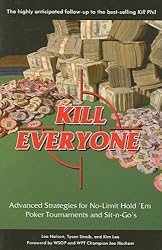
Kill Everyone: Advanced Strategies for No-limit Hold 'em Poker Tournaments and Sit-n-go's Review

Kill Everyone: Advanced Strategies for No-limit Hold 'em Poker Tournaments and Sit-n-go's
Average Reviews:

(More customer reviews)
The long awaited sequel to 'Kill Phil' has finally been published. Where 'Kill Phil' provided an effective long-ball strategy for neophyte tournament poker players to compete against expert players, 'Kill Everyone' takes the 'Killers of Phils' [who by now should have had a lot of playing experience] to another level of play.
This second book by Lee Nelson and his new collaborators [Tysen Streib and Kim Lee] details some very advanced tournament poker concepts and strategies. It is also based on the modern game [also sometimes called the 'new school'] of very strong aggression. Where 'Kill Phil' emphasized a long-ball strategy due to its target audience being beginning tournament players, this book teaches small-ball play in the early stages of a tournament, and provides further analysis of the long-ball tactics introduced in 'Kill Phil'. Thus, you now have both strategies in your arsenal to be utilized as befits the situation.
The book identifies two key phases of tournament play - the early game, where the objective is to accumulate chips, and then the end-game [when the blinds are escalating, and players are generally in the `move-in' stage], where the goal is to win it all. It is this last phase where the book excels. It is also the most useful, as this is the situation that most players find themselves in - short-stacked or average-stacked. It not only provides detailed guidelines and tables for the strategies to be used but the discussion is strongly backed up by sound game-theoretic analysis. A particularly useful discussion is equilibrium play when far from the money, .i.e. you become short stacked early in the tournament, and you can no longer play `cash poker' - how do you play your short stack optimally? The authors present a non-exploitative `jam-or-fold' strategy with adjustment guidelines to exploit your opponents should they not follow an equilibrium strategy against you. The end-game and equilibrium strategies discussion is a detailed expansion on the work presented in `Kill Phil' except that this latter work presents a deeper analysis and allows the [hopefully] now more experienced `Kill Phil-ler' to really grasp what he was doing by rote, and adapt to his opponents.
The next major section of the book presents a new and very important concept in tournament poker - `bubble factor' [new in that I don't believe that is has been discussed and developed to the extent that it has in this book]. This is defined as the `ratio of the cost of losing vs the gain from winning' when you're all-in and approaching the money in a tournament. This concept is important because it significantly affects your decision making, e.g. when would you fold aces pre-flop? Bubble factors are strongly tournament-strategic rather than poker-strategic - what is the prize pool and how is it paid out, the tournament structure, how many players are left, what is your stack size relative to other players, what is your relative position, how far from the money are you? Experienced pros have an intuitive feel for some of these issues, and now, thanks to this book, the `secrets' backed by solid mathematical analysis, are available to the rest of us. The discussion concludes by offering practical guidelines on utilizing `bubble factors' [`bubble factors' are calculated using the Independent Chip Model which makes it a tad difficult to work out at the table]. A good understanding of your opponents' bubble factors also allows you to apply `fold equity' more effectively. Chapter 7 of the book, `Specific Strategies for Different Tournament Types' then applies bubble factor strategies to different tournament types, including SnGs, MTTs and super-satellites. I have personally applied the concepts discussed here to dig myself out of trouble and end up at the final table.
And should you be fortunate enough to get heads-up against Gus Hansen, `Kill Everyone' presents you with information to not only hold your own, but to win the tournament. It has the most detailed heads-up strategy that I have seen in a poker tournament book. Again, it provides an equilibrium short-stacked strategy that would not be exploitable by the pro. It also presents a practical strategy for when the stacks are deeper.
The book then applies the concepts discussed in a detailed analysis of the Full Tilt Monte Carlo Invitational SnG. It is interesting to see how difficult it is, even for pros, to play optimally. The authors conclude by presenting a potpourri of topics including recent changes in modern tournament play, e.g. UTG steals, playing against the pros etc.
All in all, an exceptionally good book on a winning approach to the modern game of tournament poker. I personally find the chapters on equilibrium play, bubble factors, and heads-up to be very useful in my own development as a tournament player.
... and should you be unlucky enough to get knocked out of the tournament, you can read the bonus chapter on online short-handed cash games provided by the Australian pro, Mark Vos, and head up to your hotel room and login.

Click Here to see more reviews about: Kill Everyone: Advanced Strategies for No-limit Hold 'em Poker Tournaments and Sit-n-go's

Kill Phil was a revolutionary poker manual -- its simplified yet potent strategies empowered even rank novices to compete against the world's best poker players.Kill Everyone begins where Kill Phil left off. Its perfect blend of real-time experience, poker math, and computational horsepower combine to create nw concepts and advanced strategies never before seen in print for multi-table tournaments, Sit-n-Go's, and satellites.Kill Everyone explains how to choose the right strategy for the right game, provides the proper tactics, and introduces new weapons into a tournament-poker-player's arsenal. These include:* fear and fold equity*equilibrium playsbubble factorsendgame strategiesoptimal heads-up playand much much more!Unlike Kill Phil, which was 90% pre-flop strategy, Kill Everyone goes all the way. In the end, you'll know how to accumulate chips early, navigate through the middle stages, and perfect your play on the bubble and at the final table.This book is for anyone serious about playing tournament poker, both live and online. And for cash-game players, a bonus chapter, penned by online cash-game ace and 2007 WSOP bracelet winner Mark Vos, helps you develop your short-handed no-limit hold 'em cash game.

Buy Now

Buy cheap Kill Everyone: Advanced Strategies for No-limit Hold 'em Poker Tournaments and Sit-n-go's now.

11/27/2011

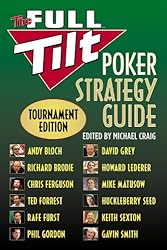
The Full Tilt Poker Strategy Guide: Tournament Edition Review

The Full Tilt Poker Strategy Guide: Tournament Edition
Average Reviews:

(More customer reviews)
I was suspicious of this book and wasn't sure it would include any new information that isn't in other poker books (Harrington or Sklansky and Malmuth). Many poker books rehash concepts (play tight early, more aggressive later). This book has several new concepts I haven't read before. For example, Howard Lederer talks about a hand versus Phil Ivey when Ivey raised. Howard raised all-in. Ivey folded. Lederer analyzes this nondescript hand and explains the concept of leverage. Andy Bloch in his preflop hands goes far beyond "play early tight, play quality hands" and gives a chart for the "Jam or Fold" game (small blind v. big blind). His chart, he believes, is superior to the Sklansky-Chubakov Jam of Fold ratings because in the S-C rankings the small blind turns up their hand. In Bloch's chart, the small blind does not (which is more realistic). Andy explains that the S-C underestimates hands such as 9-T s Jam value. Howard Lederer's chapter on Limit Holdem made me excited to play Limit holdem. He gives the reader a good limit system that the blinds can play out of position against a raiser. Chris Ferguson's chapter on postflop No Limit play is also valuable. Ferguson's chapter is like a minilesson with him. Other games besides Holdem are covered. Matusow in the 08 chapter explains why he raised with K-Q-J-6 facing heavy preflop action! The book is full of things like this. I was afraid that this book was an attempt to make a quick book on the poker boom with many authors writing a chapter for a quick paycheck and not taking responsibility for overall shoddy work. It isn't the case. You will find material here that you will not find elsewhere.

Click Here to see more reviews about: The Full Tilt Poker Strategy Guide: Tournament Edition

The professionals of Full Tilt Poker include the best and most famous poker players in the world. Their accomplishments are unparalleled, with countless World Series of Poker and World Poker Tour championships to their names and well in excess of $100 million in winnings in private games. Now, this group of poker legends has banded together to create THE FULL TILT POKER STRATEGY GUIDE, which will stand as an instant classic of the genre and is sure to become the industry standard.

Buy NowGet 34% OFF

Buy cheap The Full Tilt Poker Strategy Guide: Tournament Edition now.

10/07/2011

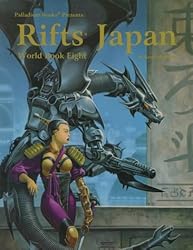
Rifts World Book 8: Japan Review

Rifts World Book 8: Japan
Average Reviews:

(More customer reviews)
This book was great! It combined old mysticism with amazing technology. The only thing it was missing was that the cool motorcycles and other vehicles that were pictured, but were not given stats on! It also made Japan seem less powerful than the "NGR" (technology wise). The old mystics (like the traditional ninja and samurai) are a little weak, as they had low mega-damage stats and refuse to use technology so you can't even fit them into a suit of power armor to protect them! A lot of it was rehash too, like the Japanese "Samas" operator and the Japanese "Glitterboy". Other than that, the weapons were pretty cool, the possible adventures are good, the OCCs are excellent, and if you combine this book with "Ninjas and superspies" it really brings it to life!

Click Here to see more reviews about: Rifts World Book 8: Japan


Buy Now

Buy cheap Rifts World Book 8: Japan now.

10/03/2011

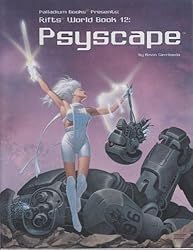
Rifts World Book 12: Psyscape (Rifts Worldbook Series) Review

Rifts World Book 12: Psyscape (Rifts Worldbook Series)
Average Reviews:

(More customer reviews)
This is a must have book fo rany Rifts adventure that uses Psyonics. There is a vast amount of material to use, but unfortunaly, a few reprints too.

Click Here to see more reviews about: Rifts World Book 12: Psyscape (Rifts Worldbook Series)


Buy Now

Buy cheap Rifts World Book 12: Psyscape (Rifts Worldbook Series) now.

3/24/2011

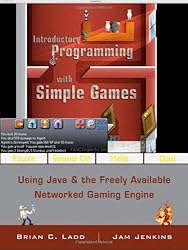
Introductory Programming with Simple Games: Using Java and the Freely Available Networked Game Engine Review

Introductory Programming with Simple Games: Using Java and the Freely Available Networked Game Engine
Average Reviews:

(More customer reviews)
I had a lot of trouble deciding if this book is worth my money, especially considering the standard cost of: $75. There are almost no reviews about this book on the internet, which was why the decision was difficult.
I ended up getting this book for $30, and I still somewhat feel ripped off. This book does have some value related to game concept and design, as well as a few interesting concepts, BUT, compared to other books with a lower price, this book isn't very good.
Because of this book, I learned the basics of what a game engine is, which is a new concept to me. I also learned a few interesting concepts of game design, but the book jumps from topic to topic. Reading the code, it seems that this book assumes you are advanced, but reading over the paragraphs, it teaches you introductory concepts such as variable initialization and arrays AFTER it was implemented in code.
This book is very confusing for beginners, and not much use to intermediate programmers, and completely useless for advanced programmers. It doesn't exactly explain what a game engine is, and how to use it properly. It doesn't explain any of the methods that the game engine contains... It just uses them...which isn't good for a beginner.
I still think that for other intermediate programmers, this book has some use by teaching you about game engine and code structure, which I haven't found yet in a book. If you are looking for a game programming book to read after introductory java books, i suggest you look into
Developing Games in Java (which is slightly difficult, but if you spend enough time on it, any beginner could understand it)
or Killer Game Programming in Java. (this is more advanced than the above).

Click Here to see more reviews about: Introductory Programming with Simple Games: Using Java and the Freely Available Networked Game Engine

This is an excellent resource for programmers who need to learn Java but aren't interested in just reading about concepts. Introduction to Java Programming with Games follows a spiral approach to introduce concepts and enable them to write game programs as soon as they start. It includes code examples and problems that are easy to understand and motivates them to work through to find the solutions. This game-motivated presentation will help programmers quickly apply what they've learned in order to build their skills.

Buy Now

Buy cheap Introductory Programming with Simple Games: Using Java and the Freely Available Networked Game Engine now.